Protecting Your Nursing Home Assets
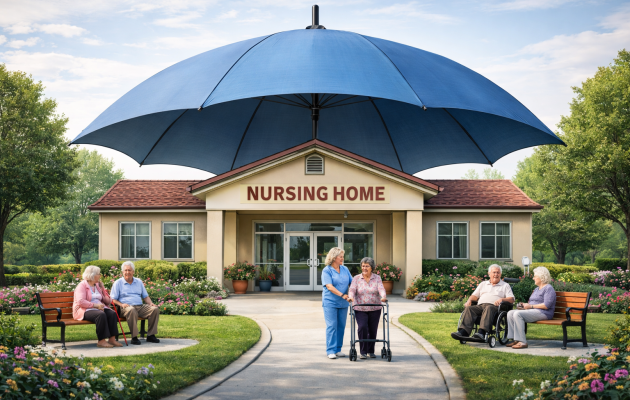
Job one for nursing homes is to protect their resident patients, and liability for any lapse in providing care has ling been a principal concern of nursing facility operators.
Today, however, property risk threatens the existence of nursing homes to an extent not previously seen.
This was dramatically demonstrated in Florida, where more than 700 nursing homes or assisted living facilities closed from 2019 through 2023, a period when commercial property premiums soared 125% across the state. Florida is an extreme example, but the trend is evident across the country as more and more communities experience catastrophic weather disasters.
The costs of these disasters are measured not only in the physical damage they cause, but in the disruption of lives of vulnerable populations, and in the cost of measures needed to prepare and recover.
The BPP and its “perils”
Insurance for damage or loss to nursing home property is provided through a “Building and Personal Property” policy.
Coverage under a BPP is provided under separate “limits” (amounts) of insurance, and only for damage or loss caused by covered “perils” (fire, wind, vandalism, etc.).
Coverage is available for--
- Named perils: those listed in the policy; or
- Open, or “special,” perils: any peril except those excluded in the policy.
Damage by some perils, including flood and earthquake, are not covered under standard property policies; additional insurance needs to be purchased to address them.
Insurance for Buildings
Damage to buildings and property affixed to buildings (plumbing, wiring, HVAC units, etc.) is covered under the building limit, the most the insurer will pay for damage to buildings and fixtures. Insurance buyers need to be aware of factors that affect the cost of insurance and the amount paid after a loss:
- How the building limit compares to the full value of the property insured. If the limit is too low, loss payments might be reduced by a “coinsurance” factor.
- Whether losses are settled on a “replacement cost” or “actual cash value” basis. The “ACV” approach factors depreciation into loss payments and will save money on premium, but will not cover the full cost to repair or replace damaged property.
- The amount of coverage available to replace undamaged parts of a structure to conform to updated building ordinances, including the exacting standards that apply to nursing homes specifically. (An entire structure under repaired, not just the damaged parts, often must be upgraded to current codes.)
This exposure for “ordinance or law” expense is typically excluded from coverage in a basic BPP policy, but coverage for it can usually be acquired by an endorsement to the policy for additional premium.
Insurance for Personal Property
Property that is not attached to a building, such as furnishings and equipment, are insured under a separate business personal property limit.
In addition to beds, supplies, and office equipment, nursing homes usually have sophisticated medical equipment used to monitor and treat the health of their residents. This equipment is costly and subject to rapid depreciation.
Under standard commercial property coverage, business personal property is usually insured on an ACV basis; loss payments are therefore limited to the depreciated value of damaged or stolen property. It may be impossible or prohibitively costly to insure personal property on a replacement cost basis. In that case, facility managers should investigate whether highly valuable pieces of property should be insured on their own through separate policies.
Covering Loss of Revenue and Extra Expenses
If a nursing home suffers severe damage, its ability to survive will depend on whether it can provide for its residents, retain its staff, and stay solvent if all or part of the facility must be shut down. Protection for that comes from “business income,” or “business interruption” insurance, typically added to a BPP policy.
There are three essential components to “BI” coverage:
- Coverage for extra expenses incurred to continue operations or shorten the length of time needed to restore operations.
- Coverage for business income lost during a suspension of operations, less any costs that are also suspended.
- Coverage for extended business income, the loss of income that continues even after operations have resumed, until revenue stabilizes at or near pre-loss levels.
The most critical need of a nursing home facing or responding to a disaster is to quickly evacuate residents to a safe location. Standard income-expense coverage won’t help if residents are evacuated in expectation of a catastrophe, only to have the threat dissipate or move off elsewhere. For that, specialized evacuation coverage or other resources would be needed.
The Globe Midwest™ Approach
Understanding the presence and implications of separate coverages under separate limits and conditions is key to making sure your premium dollar is devoted to the type of protection your facility needs, and to developing a risk management strategy that leverages your strengths and accounts for your vulnerabilities.
When your facility incurs damage or suffers a loss, you’ll want the guidance of a renowned team of insurance claim adjusters adjusting your claim on your behalf.
Globe Midwest™ specializes in serving nursing homes, and understands from years of experience in the sector how to analyze policies and promote loss settlements that capture the full amounts due to insureds.
Globe Midwest™ is a vertically integrated adjusting firm that manages all aspects of a claim through onsite inspections and direct communication with all relevant building, property, legal, and insurance personnel.
Globe Midwest™ does not outsource any of its work, and its clients enjoy firsthand contact with those managing their claims.