
Home insurance claim denied? Nearly half of all claims pay out nothing — and it's getting worse
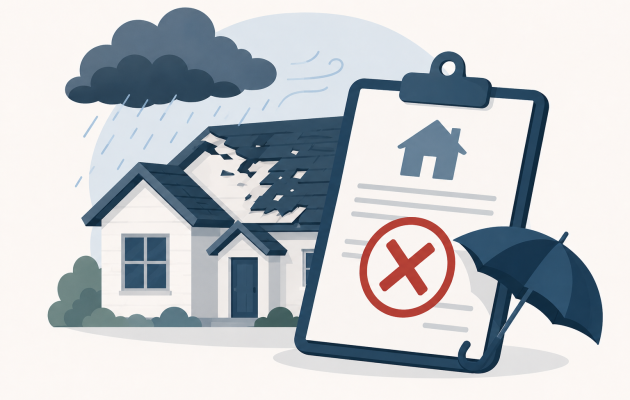
If your home insurance claim was denied or settled for far less than you expected, you are not alone. According to a landmark investigation by the Wall Street Journal, more than 44% of home insurance claims filed with America's five largest insurers were closed without any payment in 2025. A decade ago, that figure was 36%. The trend is moving in the wrong direction — and millions of homeowners are paying the price.
What the data shows
The Wall Street Journal analyzed home insurance claims data from the National Association of Insurance Commissioners (NAIC) covering the five biggest home insurers in the United States: State Farm, Allstate, Liberty Mutual, USAA, and Farmers Insurance. As a group, these companies closed without payment more than 44% of the claims they resolved in 2025. That is nearly one in two claims resulting in a zero-dollar payout for the policyholder.
USAA's non-payment rate reached 51% — meaning more than half of its resolved claims resulted in nothing for the customer. The company disputes the framing, arguing that many of those closures involved losses below deductibles or claims customers withdrew themselves. But for the homeowner on the other end of that decision, the outcome is identical: no money received.
Some regional insurers bucked the trend. Erie Insurance, for example, actually improved its payment rate over the same decade. That demonstrates the problem is not inevitable — it is a choice being made by specific carriers.
Why insurers are paying out less
Several forces are driving the rise in zero-payout claims, according to the Journal's reporting and insurance industry analysts.
The biggest driver is deductibles. Insurers have steadily raised them in recent years — both by increasing flat dollar amounts and by switching from fixed deductibles to percentage-based ones tied to the home's insured value. A 2% deductible on a $400,000 home means the homeowner must absorb the first $8,000 of any loss before coverage begins. For many storm, hail, and wind claims, that threshold alone wipes out any possible payout.
Insurers have also applied stricter internal criteria to high-cost line items, especially roof replacements. The Journal revealed that at least one major carrier maintained what plaintiffs' attorneys described as a "secret playbook" — an internal set of guidelines used by adjusters to narrow the circumstances under which a full roof replacement would be approved.
Policy exclusions are another major factor. Flood damage, wear and tear, and faulty workmanship are commonly cited by insurers to deny claims that homeowners believed were covered. In Florida, where hurricanes Helene and Milton struck back-to-back in 2024, more than 95,000 homeowners had claims denied — many because the damage involved flooding, which is excluded from standard homeowners policies.
Technology has also played a role. Digital tools make it easier than ever to file a claim, and some insurers actively encourage fast filing after disasters, sending text alerts to customers in storm zones. The result is a higher volume of claims submitted, including many that fall below deductibles — which inflates non-payment statistics, though the lived experience for the homeowner is still the same.
Real homeowners, real losses
Vicky Weidner is an emergency-room physician in South Tulsa, Oklahoma, whose million-dollar home was struck by golf-ball-size hail during a 2024 storm. An independent contractor assessed the roof damage at $49,131 and recommended a full replacement. State Farm's inspector found only $2,000 in damage — below her policy deductible — and the insurer paid nothing.
Weidner is now one of hundreds of Oklahoma homeowners suing State Farm, alleging the company applies a hidden, internally defined standard for hail damage that does not appear anywhere in the written policy. Her attorney, Jeff Marr, told the Journal that earlier cases settled by State Farm had exposed the company's approach. "They have weaponized their claims department," he said.
State Farm declined to comment on Weidner's specific case. It also dropped her coverage shortly after the denial — citing the fact that she had filed a claim, despite having paid nothing on it.
In Bradenton, Florida, Christopher and Heather Monroe's $3.7 million waterfront home sustained significant damage from Hurricane Milton. A claims professional hired by the couple assessed the loss at more than $527,000. Slide Insurance — which paid zero on 50% of its claims in 2025, up sharply from 26% in 2022 — denied the claim in full. The insurer argued in court filings that most of the damage fell under exclusions like wear and tear, and that the remaining covered losses fell below the Monroes' $33,440 deductible. The case is scheduled for trial in December 2026. "They have made us feel almost like criminals," Christopher Monroe said. "All we're asking them to do is pay the claim."
The hidden penalty: being dropped after a denial
One of the more troubling dimensions of the Journal's findings is what happens after a zero-payout denial. In most states, insurers are permitted to raise premiums or cancel a policyholder's coverage after a claim is filed — even if that claim resulted in no payment. Only a handful of states, including Texas, prohibit this practice outright.
Weidner experienced this directly. After more than a decade of paying around $10,000 a year in premiums to State Farm, she was dropped following her zero-payout roof claim. She was left to find new coverage in an already difficult market, penalized for doing exactly what her policy was designed for.
Frequently asked questions
Why did my home insurance claim get denied? The most common reasons are that your loss fell below your deductible, the damage was excluded under your policy (such as flood, wear and tear, or faulty workmanship), or the insurer's adjuster assessed the damage at a lower value than an independent estimate. Always request a written denial letter specifying the exact reason.
Can I appeal a denied home insurance claim? Yes. Most insurers have a formal internal appeals process outlined in your policy or denial letter. You can also file a complaint with your state's department of insurance. If those avenues fail, a licensed public adjuster or insurance attorney can represent your interests in further negotiations.
What is a public adjuster? A public adjuster is a licensed professional who works exclusively on behalf of policyholders — never insurance companies. They document your loss, interpret your policy language, and negotiate your settlement directly with the insurer. Most public adjusters, including Globe Midwest Adjusters International, work on contingency, meaning you pay nothing unless money is recovered for you.
Can my insurer cancel my policy after a denied claim? In most states, yes. Filing a claim — even one that results in zero payment — can trigger a premium increase or policy non-renewal. This is one of the most important reasons to have a professional advocate before and during the claims process.
How long do I have to appeal? Deadlines vary by state and policy, but most fall between 60 and 180 days from the date of denial. Some states permit lawsuits against insurers for up to five years. Do not wait — contact a public adjuster or attorney as soon as you receive a denial.
What to do if your claim was denied or underpaid
First, request a written denial letter from your insurer with the specific reason for non-payment, along with the documentation they relied upon. Second, gather your own independent evidence — contractor estimates, photographs, and third-party inspection reports. Third, file a formal internal appeal with your insurer and document every communication. Fourth, if the appeal is denied, submit a complaint to your state's department of insurance. Fifth, consult a licensed public adjuster or insurance attorney. A public adjuster can reopen negotiations and fight for a settlement that reflects your actual loss.
How Globe Midwest Adjusters International can help
At Globe Midwest Adjusters International, we represent policyholders — never insurance companies. When an insurer says no, or offers far less than your loss warrants, our licensed public adjusters step in. We review your policy, document your damage thoroughly, and negotiate directly with your insurer to pursue the full compensation you are owed under your contract.
The Wall Street Journal's data makes clear that this problem is systemic and growing. The claims process is not a neutral exercise — it is a negotiation, and the other side comes fully prepared. You should too.
If your home insurance claim was denied, underpaid, or closed without payment, contact Globe Midwest Adjusters International for a free claim review. There is no obligation and no upfront cost. We only get paid when you do.
Source: "The Home Insurance Coin Flip: Nearly Half of Claims Result in Zero Payout," The Wall Street Journal, 2025. Data sourced from the National Association of Insurance Commissioners and the Florida Office of Insurance Regulation. Reviewed by a licensed public adjuster at Globe Midwest Adjusters International.